Where the wobble happens
Balance trouble on a two-wheeler almost always appears below walking pace: driveways, curb cuts, crosswalks and loading stops. Anything that only helps once you are moving arrives too late.
I wanted to keep carrying rods and a cooler to the water after my balance stopped being reliable, so I worked out what a powered trike really gives you.
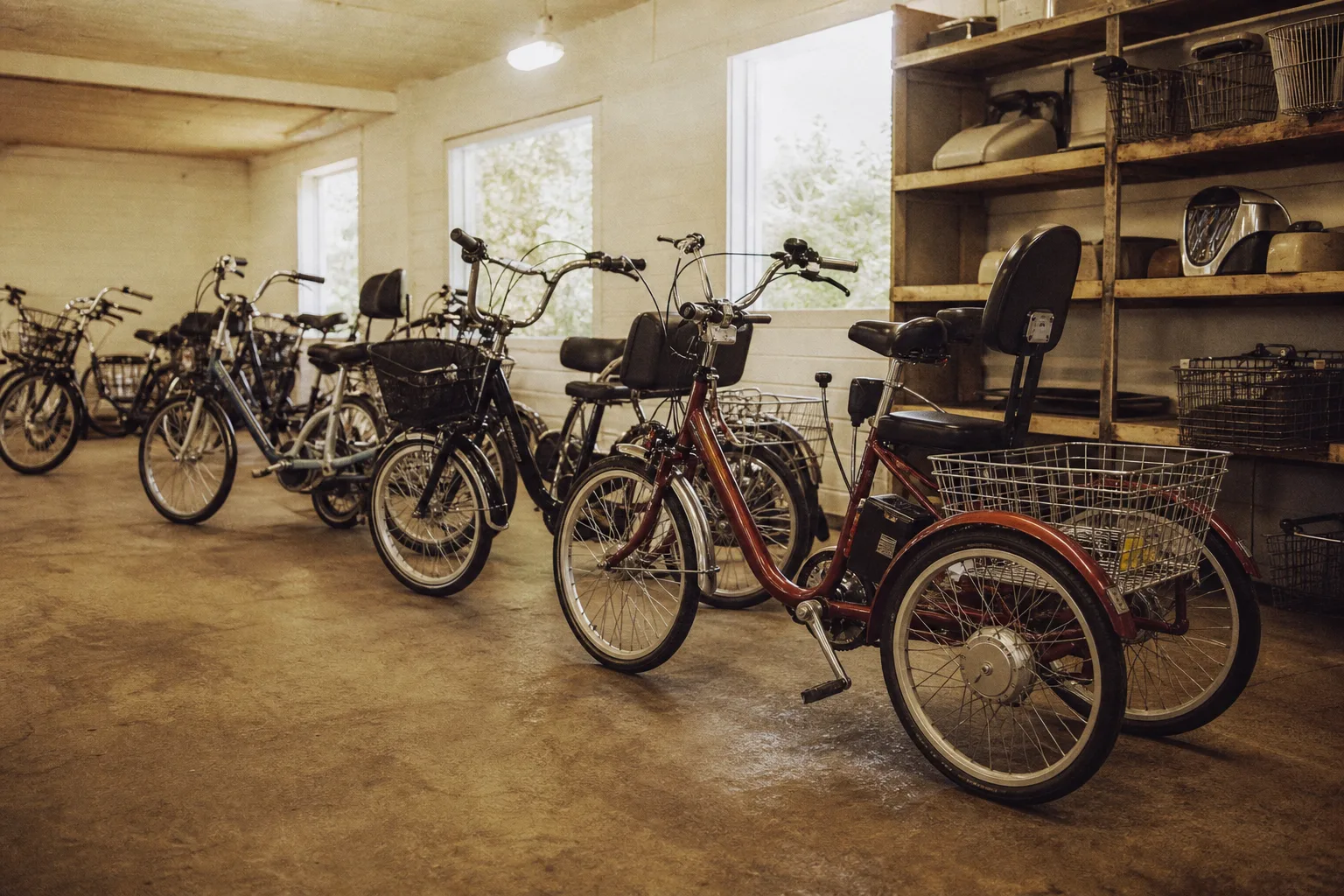
A shop comfortable with derailleurs and brake cables may not diagnose a controller or a wiring harness. Ask before buying which local shop will work on that specific drive system.
Frame layouts, motor placement, battery figures and the practical business of parking one, collected by a rider who spent months comparing them before spending the money.
Thin resale market
I wanted to keep carrying rods and a cooler to the water after my balance stopped being reliable, so I worked out what a powered trike really gives you.
People tend to arrive at this decision carrying one of two complaints, and they rarely sound alike once you make someone describe them slowly. The first is about the moment before the bike is moving: the foot that does not quite reach, the wobble pulling out of a driveway, the stop at a crosswalk with a full pannier on one side. The second is about the middle of a ride, on a grade, with the legs giving out before the hill does. Three wheels answer the first. A motor answers the second. They are separate purchases that happen to be sold in the same box.
Balance on a two-wheeler is a function of speed, and below roughly walking pace it stops being available at all, which is why the trouble almost always shows up in parking lots, at curb cuts, and at the exact moment a rider slows to look for traffic. Effort is a function of weight, grade, and gearing, and it shows up half a mile from home on the way back up. A rider who is unsteady at four miles an hour will not be helped by more power, because the power arrives after the problem has already happened. A rider who is steady but tired will not be helped by a third wheel.
A trike holds itself upright at zero miles an hour, which changes the whole shape of a trip: you can stop anywhere, put both feet down or neither, load groceries into the rear basket while the machine stands still, and start again on a slope without the lurch that a two-wheeler demands. That stability is bought with width, weight, and a different steering feel, since the frame does not lean into a turn and the rider has to slow for corners rather than counter-steer through them. The cost also shows up in storage and transport, because a trike will not stand against a wall or hang from a hook, and most car racks will not take one.
Assist does one thing well, which is to flatten terrain and headwind so the ride you can do on a good day becomes the ride you can do on an ordinary one. That matters most for cargo, since the difference between an empty machine and one carrying forty pounds of groceries is felt entirely on the climb. The charges are ongoing rather than one-time: a battery that has to be brought inside in winter and charged on a schedule, a pack that will eventually need replacing at a meaningful fraction of the price of the whole machine, and a service question, since a shop that fixes derailleurs may not touch a controller. The Consumer Product Safety Commission oversees safety requirements for bicycles and low-speed electric bicycles sold in the United States, and reputable sellers will say plainly which class a machine is built to.
The failure mode is quiet and it looks the same in both directions. Someone who was unsteady buys a fast two-wheeled assist bike, finds that the wobble at the crosswalk is now happening on a heavier machine, rides it four times, and parks it. Someone who was perfectly steady but tired buys an unpowered trike, discovers that three wheels and a steel frame make the hill harder rather than easier, and parks that. In both cases the money is spent, the resale market is thin, and the thing occupies floor space as a standing reminder. The diagnosis is cheap and the correction is not.
If both complaints are real, and for a lot of riders carrying loads they are, then the combination is the honest answer rather than a luxury, and an e trike is the shape that solves balance and effort at the same time. Price it as two solutions bought together, because that is what it is. The question worth answering before you order is whether you would still want the third wheel if the hills disappeared tomorrow, and whether you would still want the motor if the route were flat. A clear yes to both makes the number easier to look at.
Ride something you already own, or borrow one, and pay attention to where the ride goes wrong rather than to how it feels overall. Note whether you dismount early at intersections, whether you avoid certain turns, whether you plan routes around stops or around grades. Then load it: put twenty-five pounds in a bag and repeat the same trip, because weight exposes both problems and tells you which one gets worse faster. A shop that will let you ride a trike around a lot for ten minutes will settle the steering question in a way no amount of reading will, and most of them will.
The useful outcome of that half hour is a sentence you can say out loud: I need to be able to stop anywhere, or I need to get up the hill on Fourth Street with a full basket, or both. Every specification that follows, motor placement, battery capacity, frame width, turning radius, then has something to be measured against.