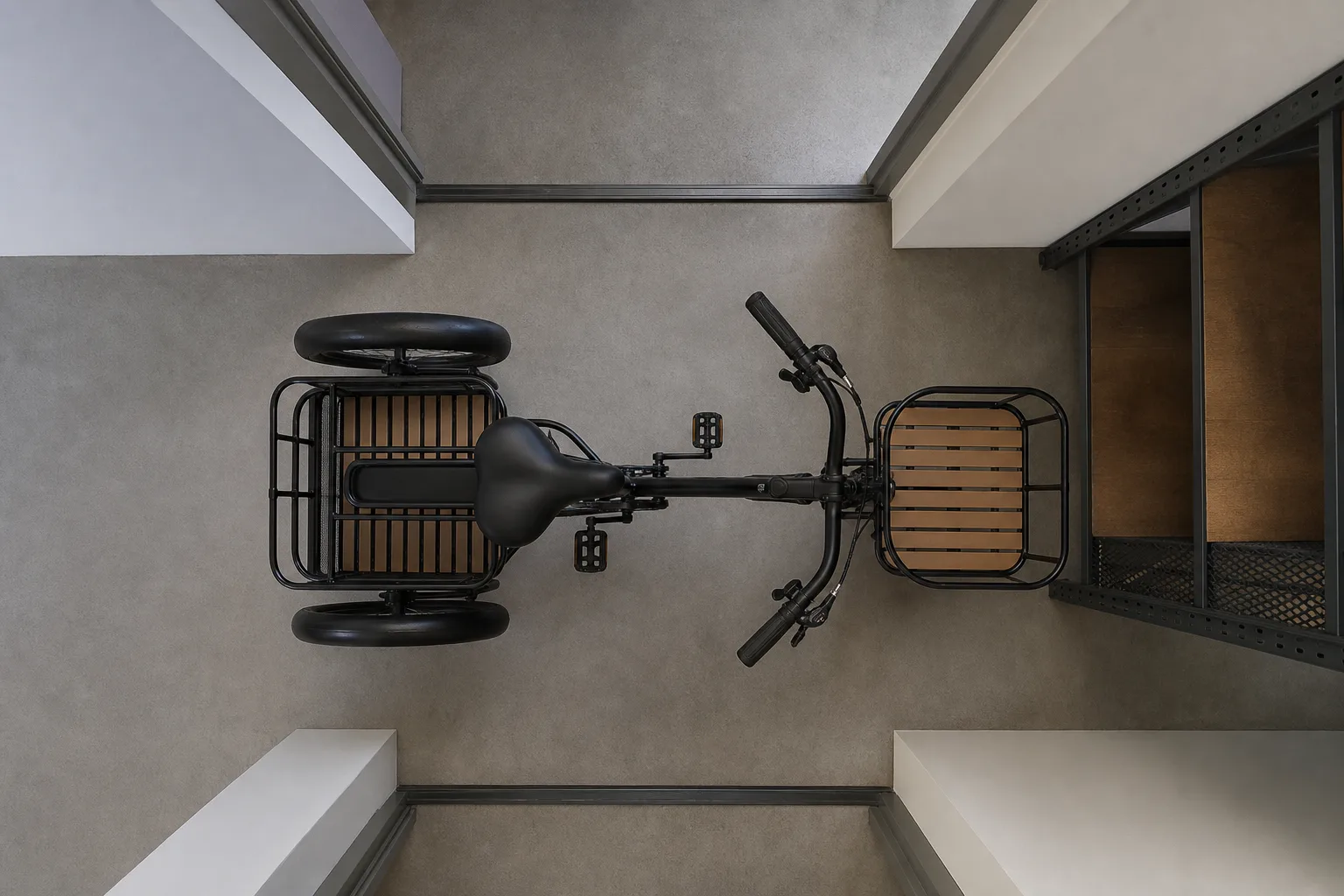
A two-wheeled bicycle forgives almost every storage sin, because it can be stood on end, hung from a hook, turned sideways in a hallway or wheeled through a gap narrower than its own handlebars. A three-wheeled cycle forgives none of them. It has a fixed footprint, it cannot be tipped without unloading, and it arrives on a pallet at a weight most people underestimate by twenty or thirty pounds. The measurements that matter are all knowable in advance, with a tape measure and twenty minutes, and almost nobody takes them until the crate is already in the driveway.
1. Track width against the narrowest opening on the route
The number that governs everything is track width, the distance between the outer faces of the rear tires, which on adult trikes commonly falls somewhere in the low thirties of inches. The number that has to clear it is not the garage door but the narrowest point on the whole path, and that is usually a side door, a gate post, or the gap between a parked car and a workbench. Standard residential door openings leave a clear width smaller than the frame suggests once the stop and the hinge swing are counted. Measure the clear opening with the door held fully open, then subtract nothing and add nothing, and compare it against the trike's widest static dimension including any rear rack or fender flare.
2. The turning circle you actually have, not the one on the spec sheet
A trike does not pivot. It sweeps, and the sweep is set by wheelbase, steering geometry and how much the front wheel can turn before the crank arm meets the frame. In a two-car garage that already holds a car, a recycling bin and a water heater, the usable turning space is often a rectangle rather than a circle, and the practical question is whether the machine can be walked in forward and walked out forward without a three-point shuffle. Chalk the outline on the floor before delivery. Push a hand truck loaded with a couple of bags of concrete through the same arc and the answer becomes obvious in about a minute.
3. What a folding frame buys, and what it costs
Folding models solve a real problem, which is a storage bay too short or too narrow for a fixed frame, and they solve it by putting hinges in the main tube, the stem, or the rear axle assembly. Every hinge is a joint that has to be clamped, and clamped joints introduce a small amount of flex under load that a welded frame does not have. Riders carrying groceries at low speed rarely notice it. Riders loading a hundred pounds into a rear basket and taking a driveway apron at an angle sometimes do. The trade is usually worth making when the alternative is no storage at all, and the fold is best tested by hand, once, before purchase, because some designs shed six inches of width and others shed sixteen.
4. Ramps, thresholds and the angle a low-step frame can climb
Getting the machine over a threshold, up a step into a shed, or into the bed of a truck is a question of ramp length and load rating rather than strength. A short ramp makes a steep angle, and a steep angle drags the low-step frame's underside or lifts the front wheel free of the surface at the transition, which is where control is lost. Longer ramps, rated well above the combined weight of trike, battery and cargo, cost more and store awkwardly, and they are still the right answer. Check the rating stamped on the ramp itself, not the marketing copy, and check it against the trike's shipping weight rather than its bare frame weight.
5. Hitch racks, tie-downs and the numbers stamped on the receiver
Most bicycle hitch racks are engineered around a bicycle, meaning a per-bike capacity in the fifty to sixty pound range and a wheel tray sized for a single track. An electric trike exceeds both. Racks built specifically for trikes and heavier electric machines exist, and they publish a tongue weight requirement that has to be matched against what the vehicle's receiver is rated to carry, a figure found in the owner's manual and on the receiver label. Tie-downs should capture the frame at three points, not the wheels alone. The Consumer Product Safety Commission oversees safety standards for bicycles and related equipment sold in the United States, which is a useful reminder that ratings printed on a rack are the ones to trust.
None of this is difficult, and all of it is cheaper to resolve with a tape measure than with a return shipment. The riders who are happiest six months in are generally the ones who chalked the garage floor first, then chose the trike that fit the space they already had.