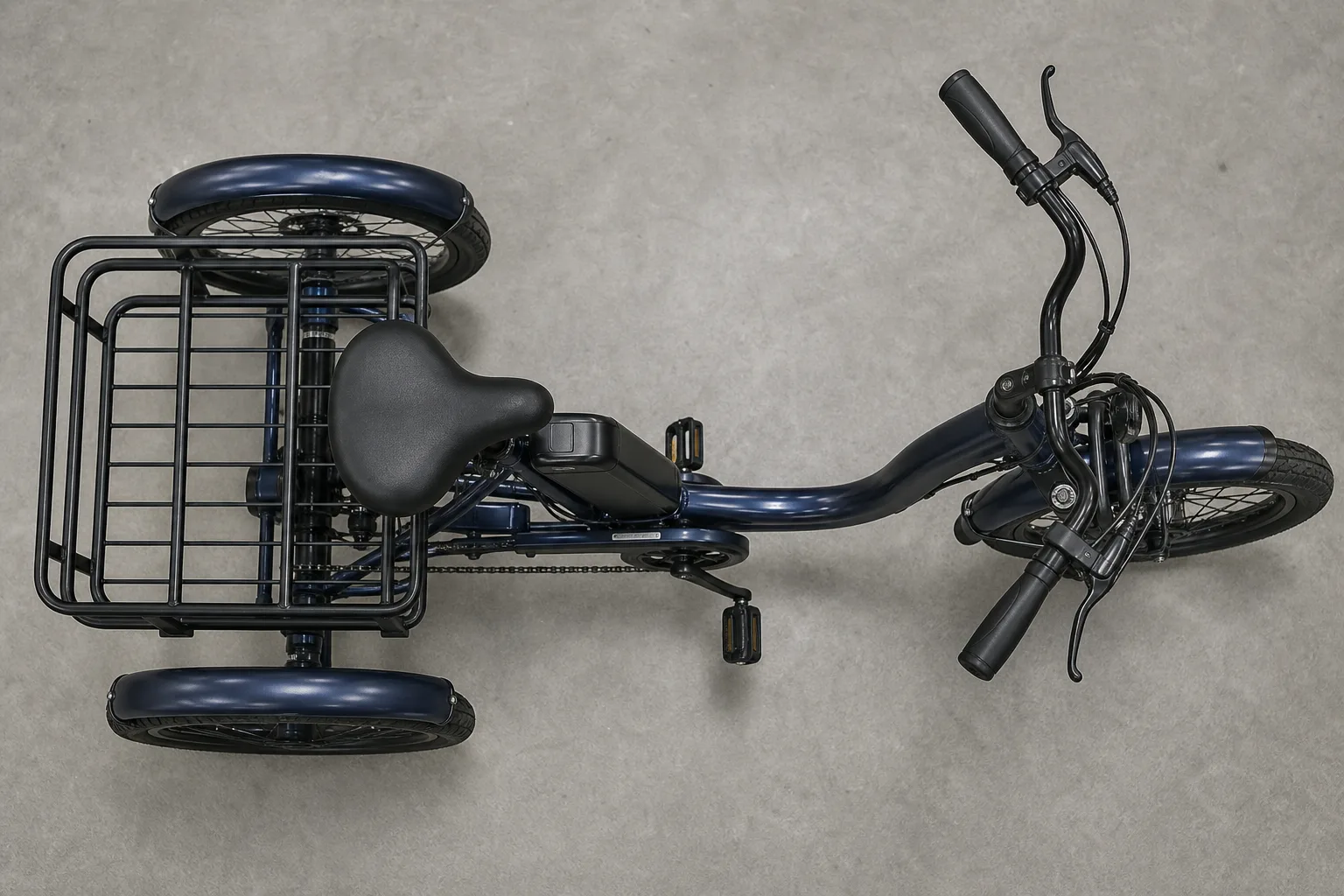
A three-wheeled electric cycle weighs more empty than most two-wheeled bikes weigh loaded, and that single fact reorganizes every number in the spec sheet. Sixty-five pounds of frame, a rider, and a rear basket with forty pounds of groceries in it is a different machine from the one the range figure was measured on. The motor rating, the battery capacity and the claimed miles all describe a best case that nobody actually rides. Reading them well is mostly a matter of knowing which assumptions each number is quietly making, and then asking the seller to confirm or deny them in writing before the money moves.
Hub and mid-drive, under load rather than on paper
Nearly every adult trike sold in the United States uses a hub motor, and on this kind of frame that is a defensible choice rather than a compromise. A hub motor drives the wheel directly, ignores the chain and the gears entirely, and therefore survives the clumsy shifting that a heavy trike invites at low speed. The tradeoff is that a hub motor has one gear ratio forever, so it does its worst work at the moment you need it most: pulling a loaded trike from a standstill on a grade. A mid-drive turns the crank instead, borrowing the drivetrain's gearing, which means a low gear multiplies its torque the same way it multiplies yours. On a steep street with a full basket, that difference is the whole conversation.
What a careful reader looks for is torque in newton-meters, not just the watt rating, because watts describe sustained power and torque describes the shove off the line. Many trike hub motors land somewhere in the range of forty-five to eighty newton-meters, and the higher end of that pulls a loaded machine up a real hill without the rider standing on the pedals. Ask where the motor sits, too. A rear hub on a trike usually drives one wheel only, through a differential or, more commonly, without one, and that asymmetry is worth understanding before your first loaded turn.
Volts times amp hours, and nothing else
A battery's honest size is its watt-hours, and watt-hours are simply volts multiplied by amp hours. A 48-volt pack rated at 14 amp hours holds 672 watt-hours; a 36-volt pack at 14 amp hours holds 504, despite the identical amp-hour number on the sticker. Sellers who quote amp hours alone are comparing two things that are not comparable, and the fix is arithmetic you can do in your head at the counter. Then work backward from consumption. A loaded trike on flat ground with moderate assist tends to draw roughly twenty to thirty watt-hours per mile, and hills, headwinds, cold weather and heavy cargo push it toward and past the top of that band.
Run that math against an advertised range and the assumptions surface quickly. A claimed fifty miles from a 672-watt-hour pack implies about thirteen watt-hours per mile, which is a light rider, minimum assist, flat pavement, no cargo and no wind. Nothing dishonest happened; the test conditions simply were not yours. Plan on half the advertised figure for real errands and you will rarely be disappointed, and you will size the pack correctly the first time.
What to ask about the cells, and what a replacement runs
Cells are where the price differences hide. Ask which cells are inside, by manufacturer and format, since packs built on named cells from established manufacturers in the common 18650 or 21700 formats behave predictably and age slowly, while unbranded cells do neither. Ask whether the pack and the complete cycle carry UL 2849 or UL 2271 certification, which covers the electrical system rather than any single component, and ask what the battery management system does about low temperature charging. The Consumer Product Safety Commission oversees the safety of consumer products including these batteries, and its attention to lithium packs has made certification a normal question rather than a rude one.
Then ask the cost of a replacement pack, and get the number before purchase rather than in year four. Replacement batteries for trikes generally land in the low hundreds to somewhere near a thousand dollars depending on capacity and cell quality, which on an inexpensive machine can approach a meaningful share of what the whole trike cost. Confirm the seller stocks that pack, confirm it fits your specific frame year, and confirm how long the warranty covers capacity loss rather than outright failure.
Every one of these questions has an answer a good seller can give in a sentence. The ones who answer quickly are usually the ones whose numbers survive the arithmetic.